(Thesis) Implementing Playa Dust as Sources for Particulate Chloride in GEOS-Chem
University of Utah • Atmospheric Chemistry • GEOS-Chem • Fortran Coding
Summary
This thesis addressed a missing process in how large-scale air quality models represent chlorine chemistry over land. While these models already capture chlorine reactions from sea spray, they typically do not account for chloride carried by dust emitted from drying saline lakebeds. As saline lakes shrink across the western United States, exposed playas become sources of chloride-rich dust that can mix with pollution and drive harmful secondary chemical reactions. These effects have been observed in field measurements but were not previously represented in the model.
I designed and implemented a modeling framework to add this missing pathway. This involved mapping playa surfaces across the United States, calculating dust emissions from these surfaces, integrating these emissions as a new chloride inventory, and enabling key chemical reactions within the model’s chemistry schemes. Together, these developments added a new capability to begin understanding how shrinking saline lakes affect air quality and how their chemical impacts may evolve in the future.
I evaluated the impact of this new capability across the United States during periods of elevated dust activity over western playa regions and compared model behavior to existing observational and modeling case studies. The results show that drying saline lakebeds can meaningfully worsen air quality through secondary chemistry and that their influence depends on emissions and model parameters. This thesis is currently being prepared for publication and serves as the foundation for multiple follow-on studies.
Skills Required & Applied
- Atmospheric chemistry
- Dust emission/saltation theory
- Modeling (GEOS-Chem, FENGSHA, STILT, HEMCO)
- Large data (Vector/Raster Files, NetCDF, xarray)
- Scientific/model evaluation
- Coding (Fortran, Python, R, Batch, Linux)
- HPC workflows
- Communication (conferences, poster, presentations)
Background
Saline lakes are shrinking, exposing new dust-emitting surfaces
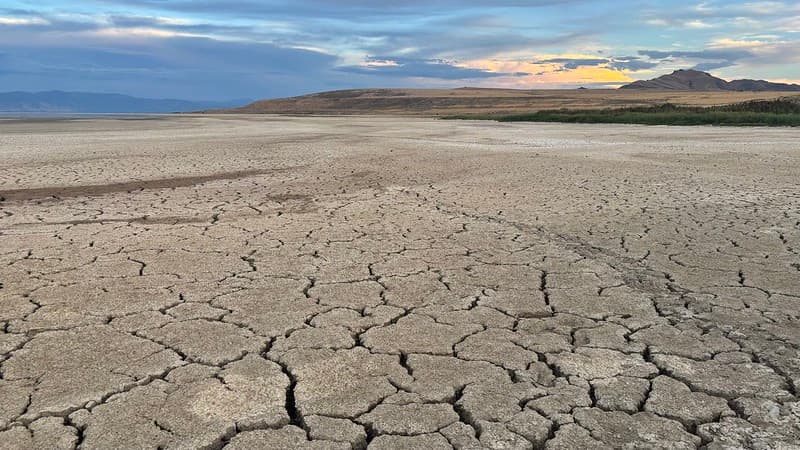
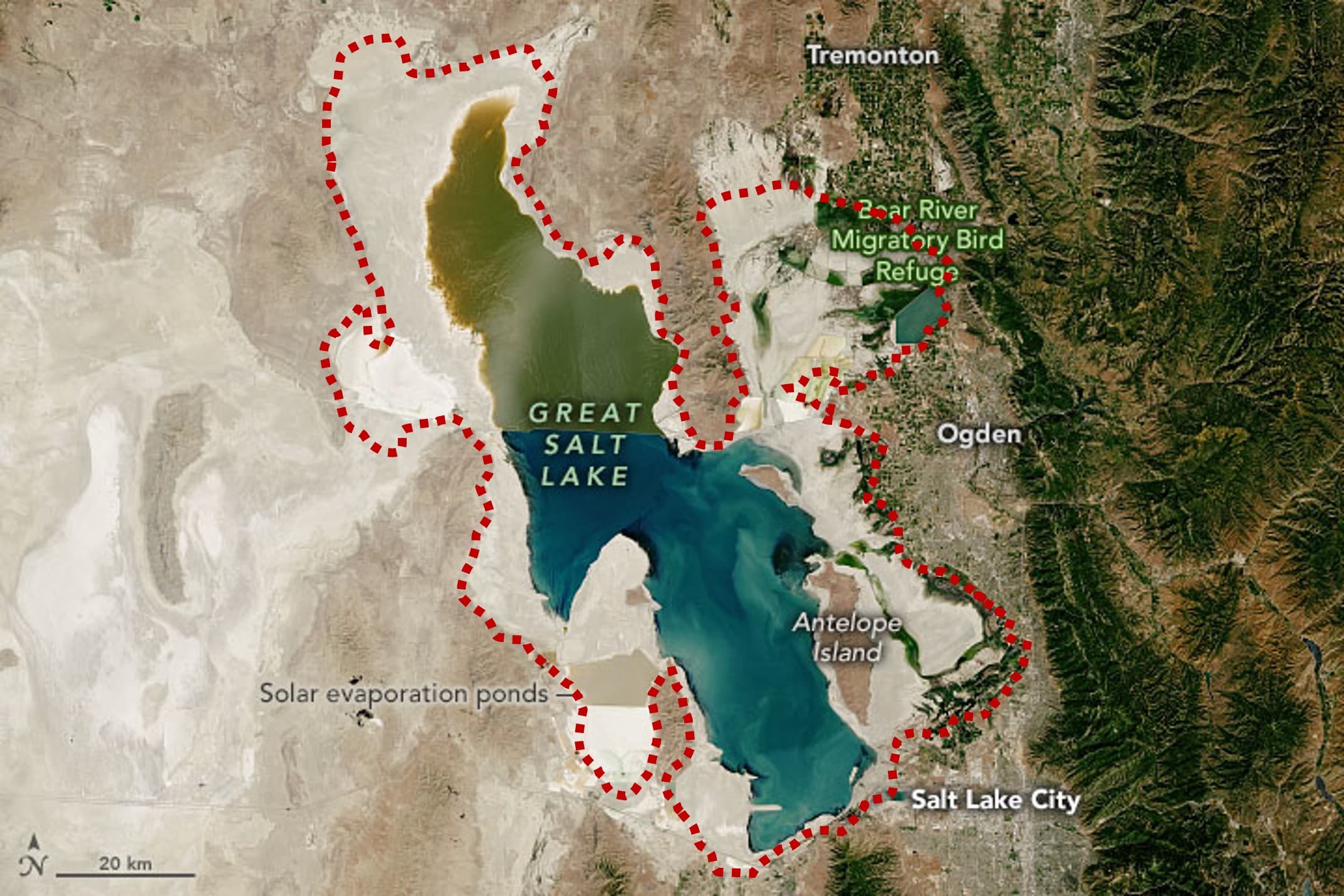
Across the western U.S., major saline lakes are shrinking due to a combination of drought and upstream water use. As lake levels fall, large areas of lakebed are exposed. These dry, salty surfaces can become major dust sources—affecting ecosystems, nearby communities, and regional air quality.
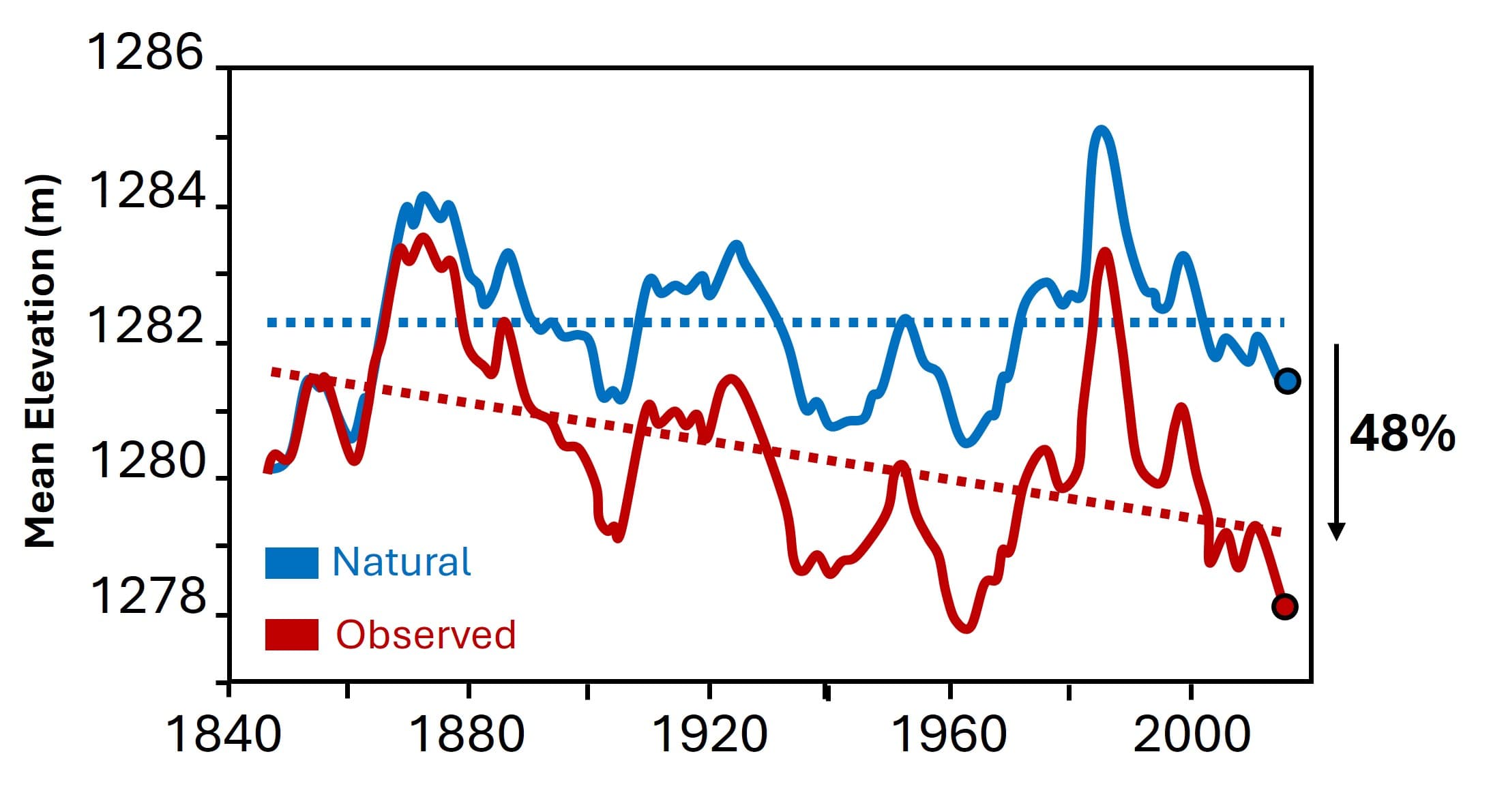
Salt Lake City’s namesake, the Great Salt Lake, has been influenced by human water diversions since the arrival of settlers in the mid-1800s, when its inlet rivers began to be redirected for agriculture and development. Although the lake naturally fluctuates, long-term declines in surface area and volume are strongly linked to these diversions: today, roughly 40–50% of the river flow that would naturally reach the lake is diverted upstream. Maintaining lake levels is critical—the Great Salt Lake supports habitat for millions of migratory birds, influences regional weather (including lake-effect precipitation), and helps suppress dust from exposed lakebed that can degrade air quality along the Wasatch Front. As a result, the lake is estimated to be roughly 50% below the level it would reach if humans were not diverting water.
Shrinking saline lakes generate unhealthy dust
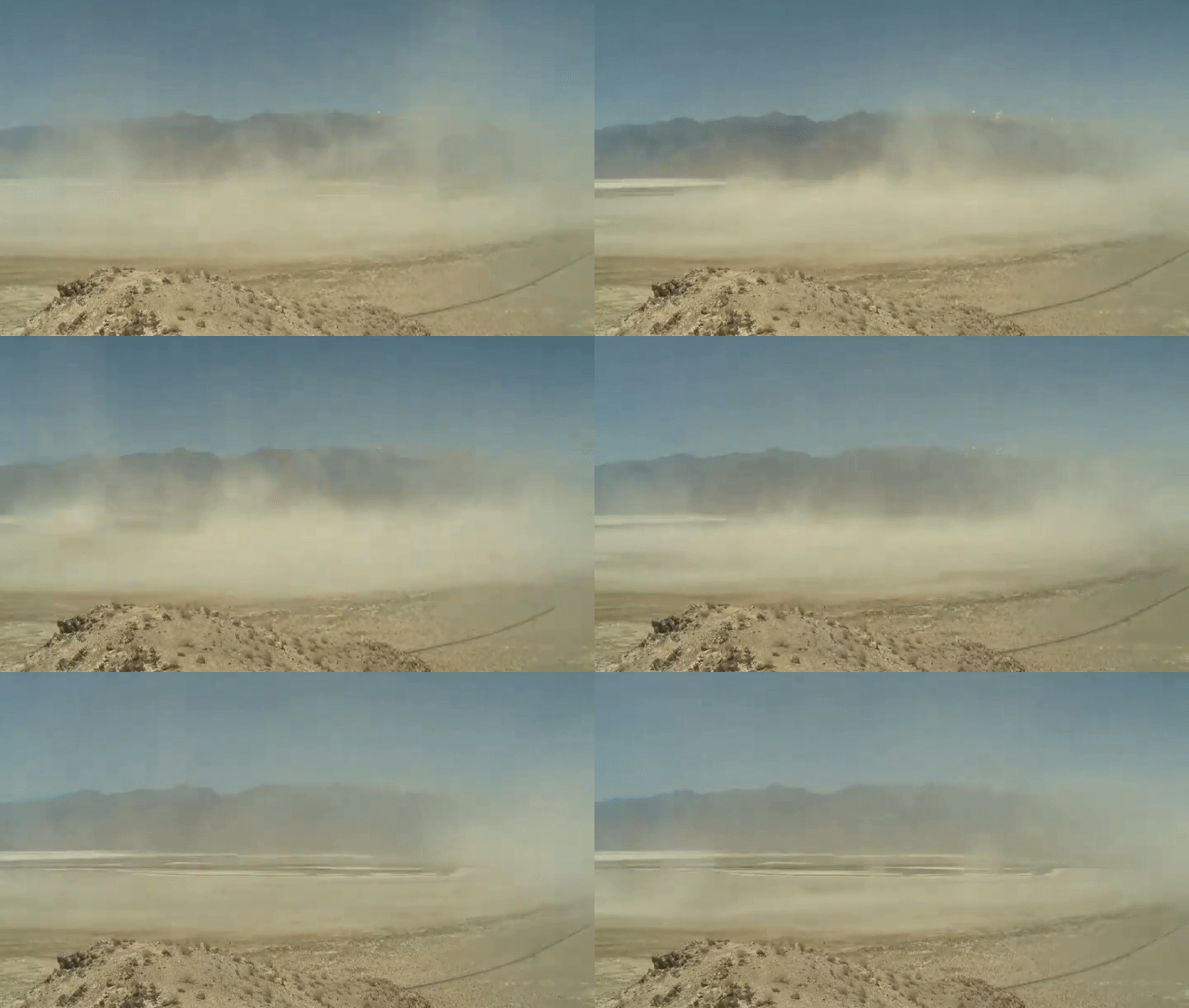
When strong winds blow across exposed lakebeds, they can loft fine dust that travels downwind into population centers. Numerous studies have shown that these dust events are directly linked to increased respiratory illness, as high concentrations of fine particulate matter degrade air quality and stress the respiratory system.
How does playa dust alter atmospheric chemistry and air quality?
Despite evidence from field and laboratory studies that saline playa dust can be a significant source of atmospheric chloride, no global atmospheric chemistry model currently represents playa dust as a chloride source. As a result, the tools needed to simulate and understand the chemical and air-quality impacts of playa dust are largely absent from large-scale modeling frameworks. This gap limits our ability to quantify how observed playa dust emissions influence atmospheric chemistry, downwind air quality, and pollutant formation.
Chloride in dust is important because it can actively influence atmospheric chemistry once it mixes with polluted air. In contrast to typical mineral dust emissions that mainly act as particles, particulate chloride can participate in chemical reactions that affect how nitrogen oxides and other pollutants behave. These reactions can enhance air-quality impacts beyond what would be expected from dust mass alone, particularly in regions influenced by urban and industrial emissions.
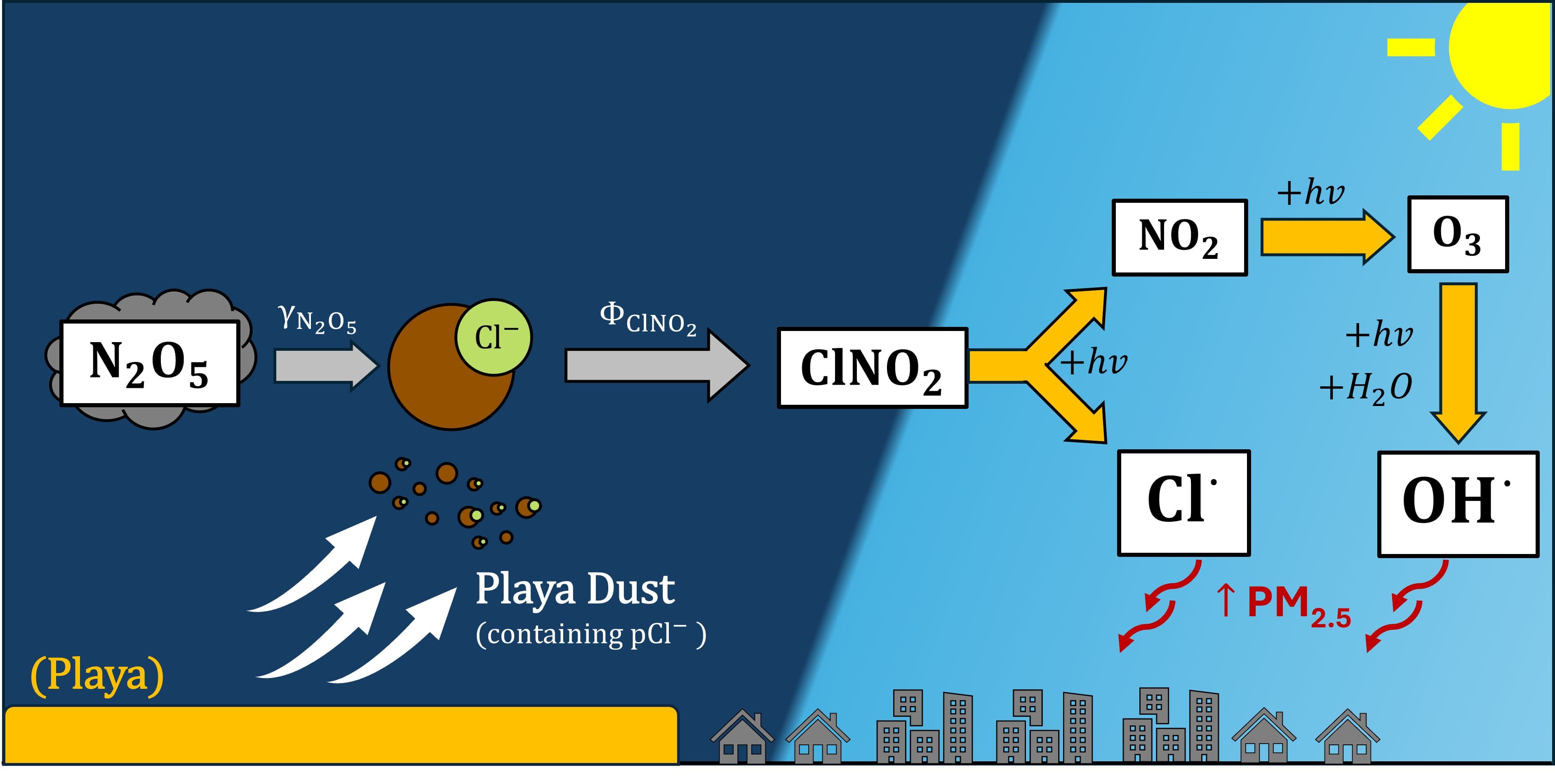
One important pathway occurs at night, when nitrogen oxide pollution forms a temporary reservoir known as N₂O₅. When N₂O₅ encounters particles that contain chloride, chemical reactions within the particle can produce ClNO₂. After sunrise, ClNO₂ breaks apart in sunlight, releasing reactive chlorine that can drive additional chemical reactions downwind and further degrade air quality beyond the direct effects of dust alone.
In the figure below, I illustrate the relevant chemical pathways linking chloride-rich dust to secondary atmospheric chemistry:
Methods
How I implemented playa dust & chloride chemistry into GEOS-Chem
GEOS-Chem is a global chemical transport model that simulates atmospheric chemistry and the transport of aerosols and trace gases. To implement playa dust as a source of inland particulate chloride within GEOS-Chem's framework and to model the associated chemistry, I followed the steps below:
- Mapped playa surfaces across the United States. I created a high-resolution playa mask from USDA soil and salinity survey data and formatted it into a gridded dataset.
- Built a playa dust emissions inventory. I modeled/calculated dust emissions from the gridded playa sources using meteorological reanalysis data and then formatted and integrated the gridded emission results for use in GEOS-Chem.
- Enabled chloride and halogen chemistry pathways. I linked emitted playa dust to NOx-related chemical pathways, allowing particulate chloride to participate in halogen chemistry relevant to regional air quality.
- Ran baseline and modified simulations and evaluated impacts. I compared dust and chemistry results between base and modified model runs and evaluated the models against available field measurements to assess model performance and the influence of playa dust on secondary chemistry.
Step 1 • Map Playas
Mapping playas into a model-ready source mask
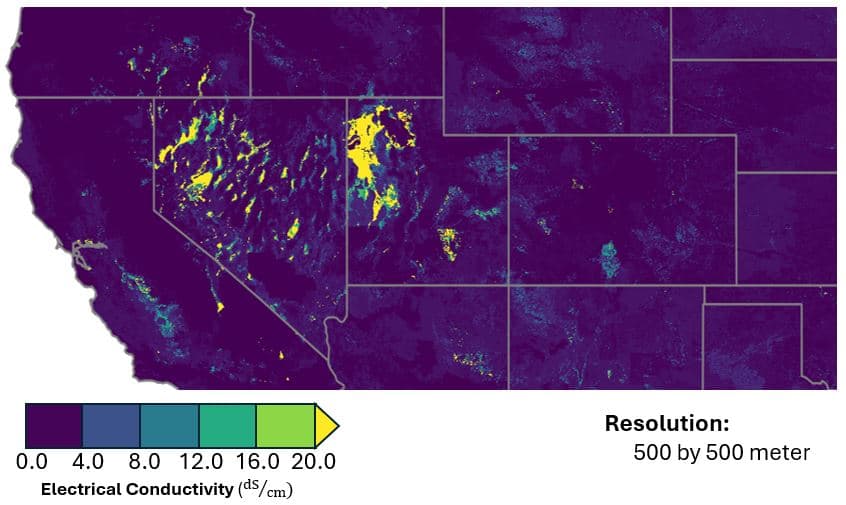
To identify where playa dust can be emitted, I first mapped the spatial distribution of playa surfaces across the United States using data from the SSURGO soil database. SSURGO provides high-resolution information on soil properties, including electrical conductivity.
Because playa surfaces are typically salt-rich, they tend to exhibit elevated electrical conductivity. By organizing the SSURGO data into a uniform, high-resolution grid in QGIS and isolating regions with consistently high conductivity, I was able to distinguish playas from surrounding soil types and create a model-ready playa source mask.
Once playa locations were identified, the next challenge was representing their dust emissions within GEOS-Chem. The model relies on precomputed, offline dust emission inventories, but its native dust sources and emission framework are too simplified and spatially inaccurate to realistically represent dust emitted from inland playa surfaces.
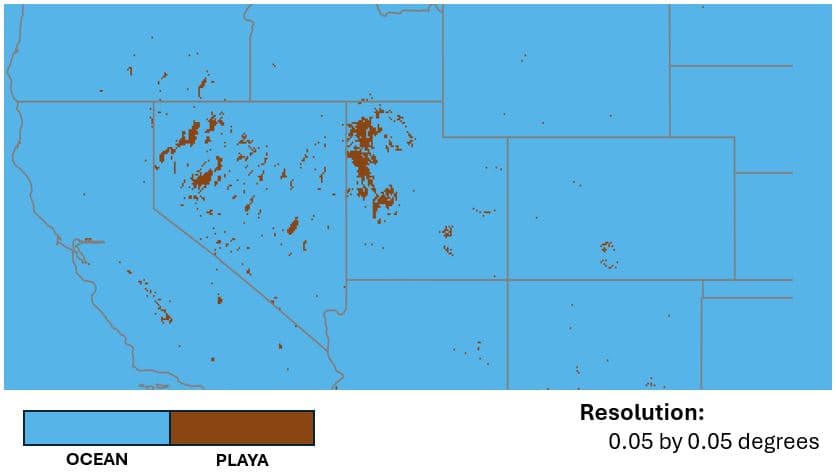
To overcome this limitation, I generated a new offline dust emission inventory using FENGSHA, a more physically based dust emission model. I constrained FENGSHA to emit dust only from grid boxes identified as playas, then formatted and integrated this inventory into GEOS-Chem’s existing dust framework. This approach allowed playa dust to be transported and deposited using standard model processes, while also enabling the playa dust to participate in chemical reaction pathways rather than being treated as chemically benign.
Step 2 • Build Emission Inventory
Using GEOS-Chem to transport playa dust and ingest the inventory
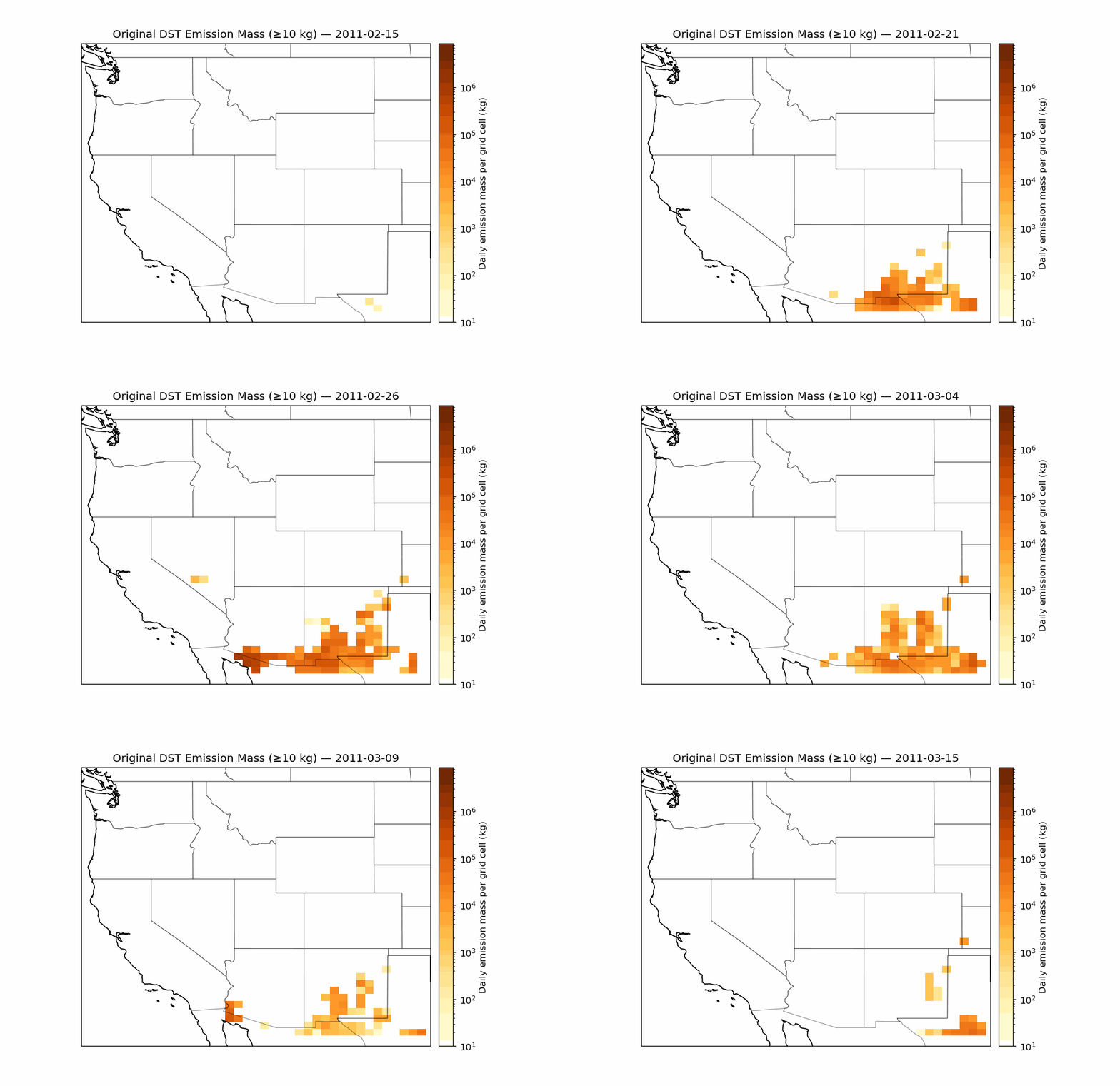
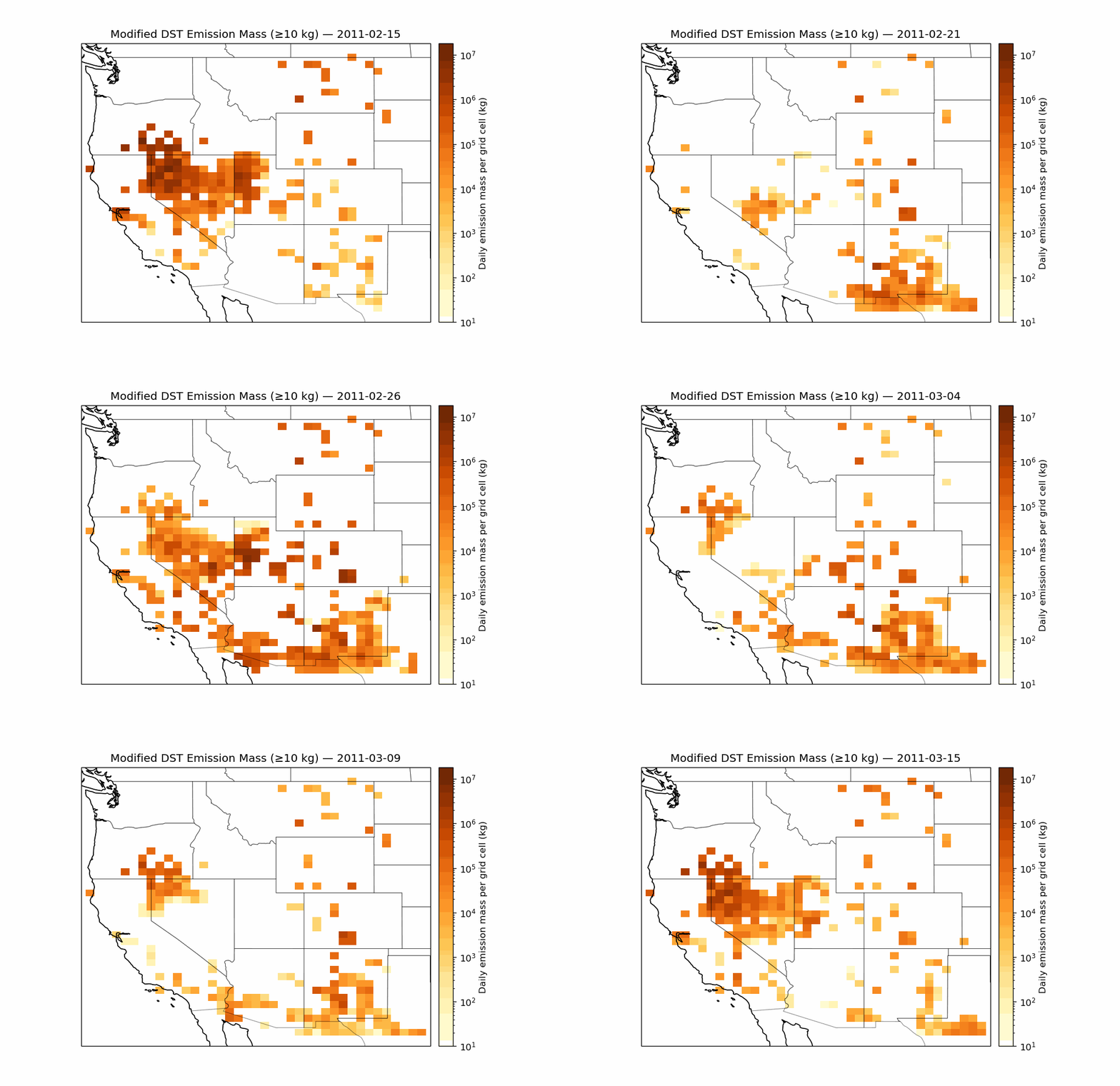
The left animation shows dust emissions from the base GEOS-Chem model during a period when playa dust was known to be elevated across the western United States due to strong westerly wind events over playa regions. Even under these favorable conditions, the model produces relatively weak dust emissions.
The right animation shows dust emissions after integrating a playa-specific emission inventory generated using FENGSHA during the same period. Emissions are more widespread and better aligned with known playa source regions, resulting in substantially stronger and more realistic dust emission patterns.
Step 3 • Chemistry implementation
Adding chemical reaction pathways for new playa dust species
With the dust emission scheme modified to include playa dust species, I enabled chemical pathways that allow the chloride content of playa dust to participate in atmospheric reactions. When playa dust is emitted or transported into a grid box that also contains dinitrogen pentoxide (N₂O₅), GEOS-Chem can produce nitryl chloride (ClNO₂) within that grid box.
Below is a concise reaction list illustrating nighttime NOₓ reservoir chemistry, heterogeneous N₂O₅ uptake on chloride-containing playa dust aerosols, and the subsequent photolysis (sunlight) reactions that releases reactive chlorine (ClNO₂).
Step 4 • Run & Evaluate
Playa dust's impact on NOₓ chemistry
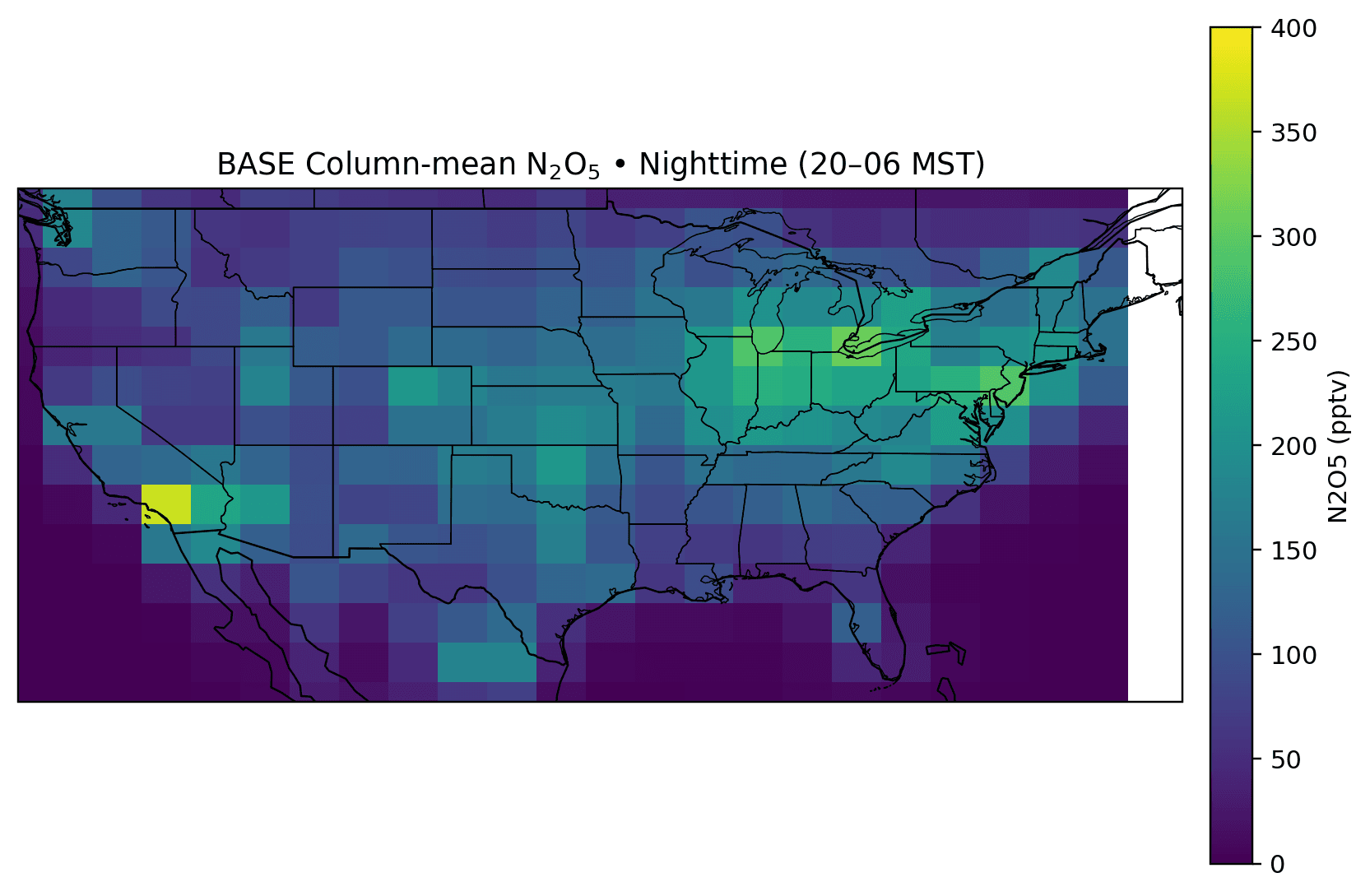
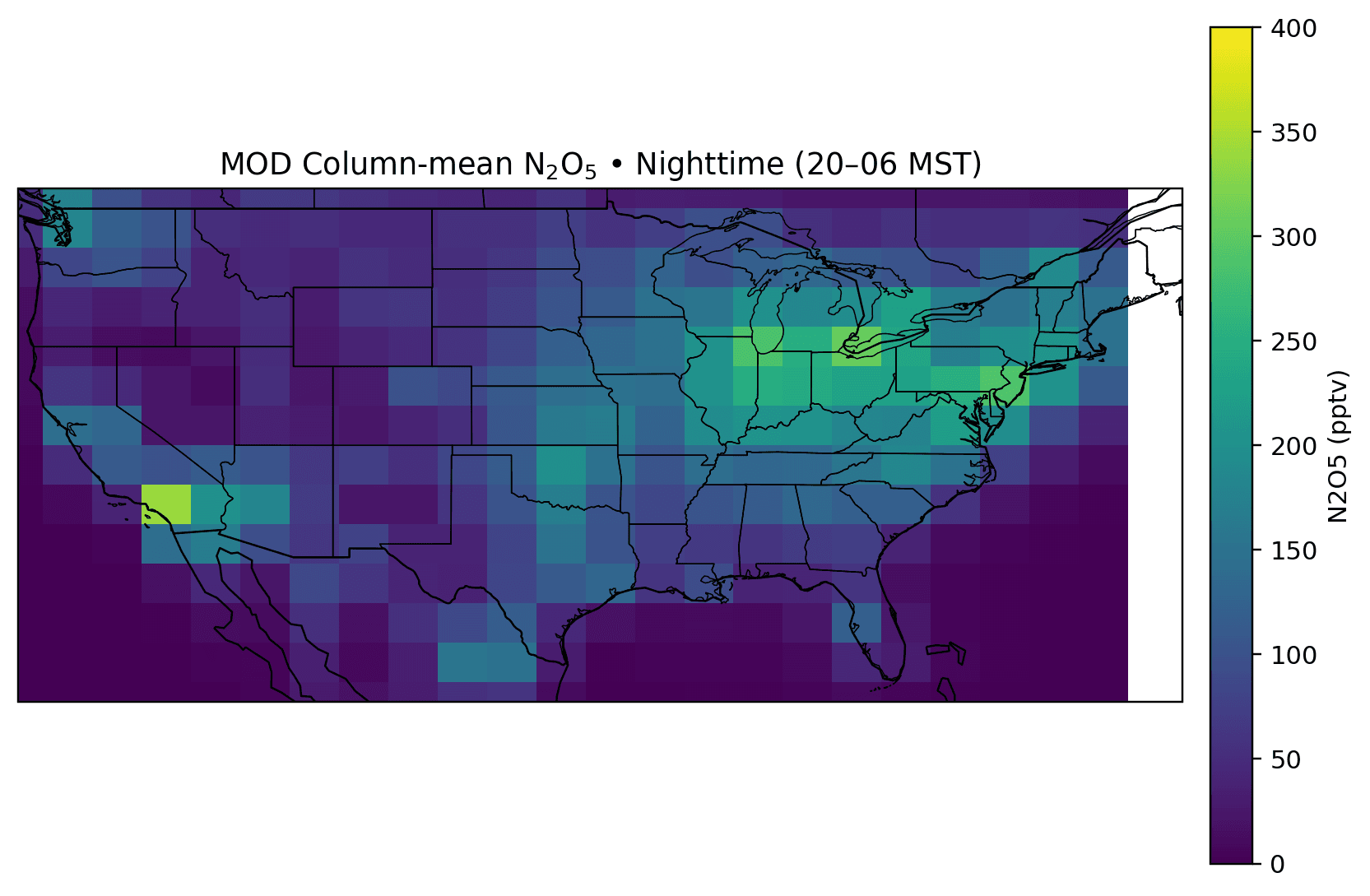
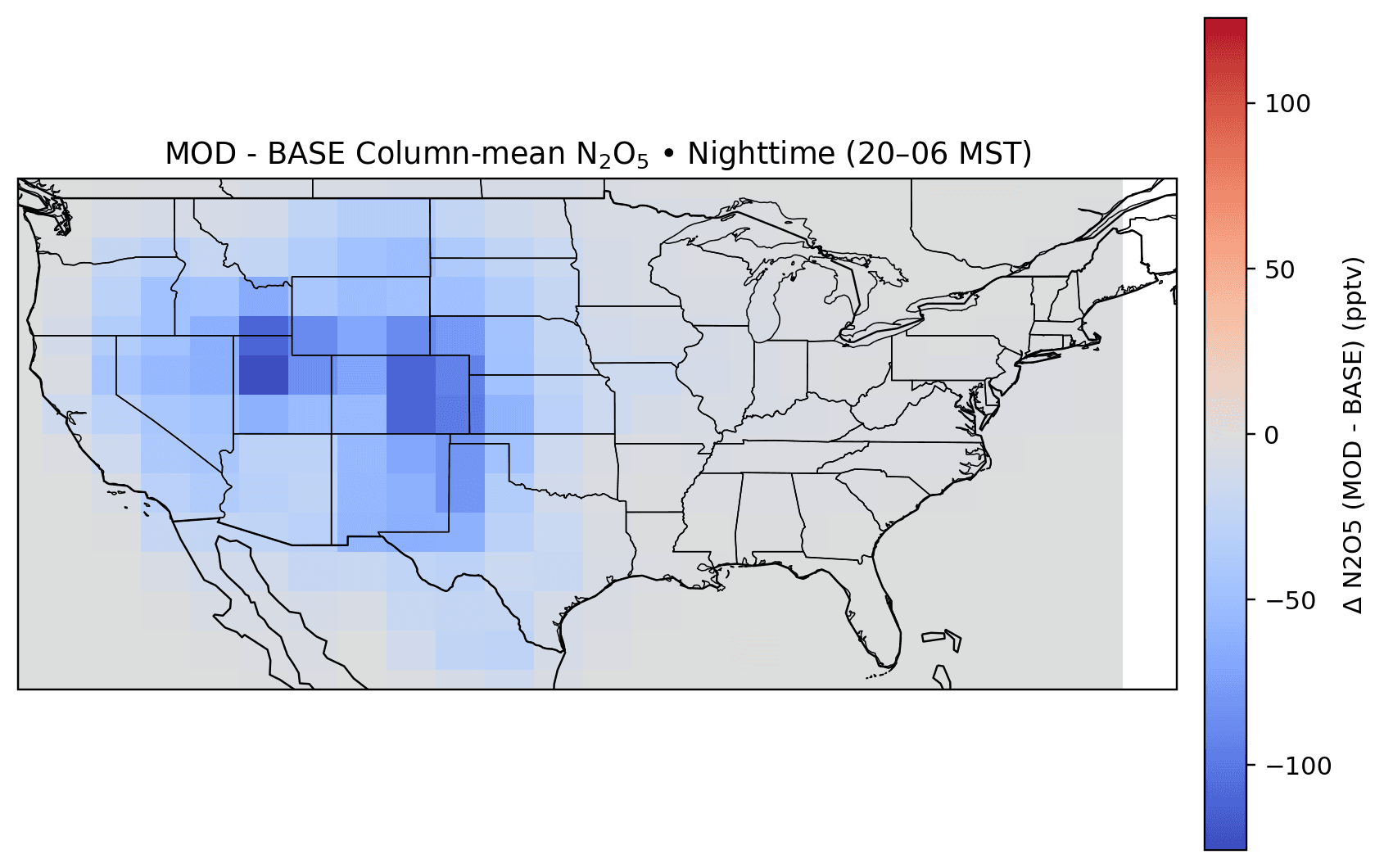
These maps show how my modifications to GEOS-Chem introduce a new loss pathway for N₂O₅ through reactions with playa dust. I evaluated the model during a period with elevated dust emissions, when playa dust was actively emitted from drying saline lakes. In these regions, playa dust reacts with N₂O₅ and removes it from the atmosphere, leading to slightly lower N₂O₅ concentrations downwind of playa source areas.
With this loss mechanism established, it can be further refined alongside improved N₂O₅ representations. This provides a pathway toward more accurate treatment of playa dust emissions and N₂O₅ chemistry within GEOS-Chem.
Step 4 • Results
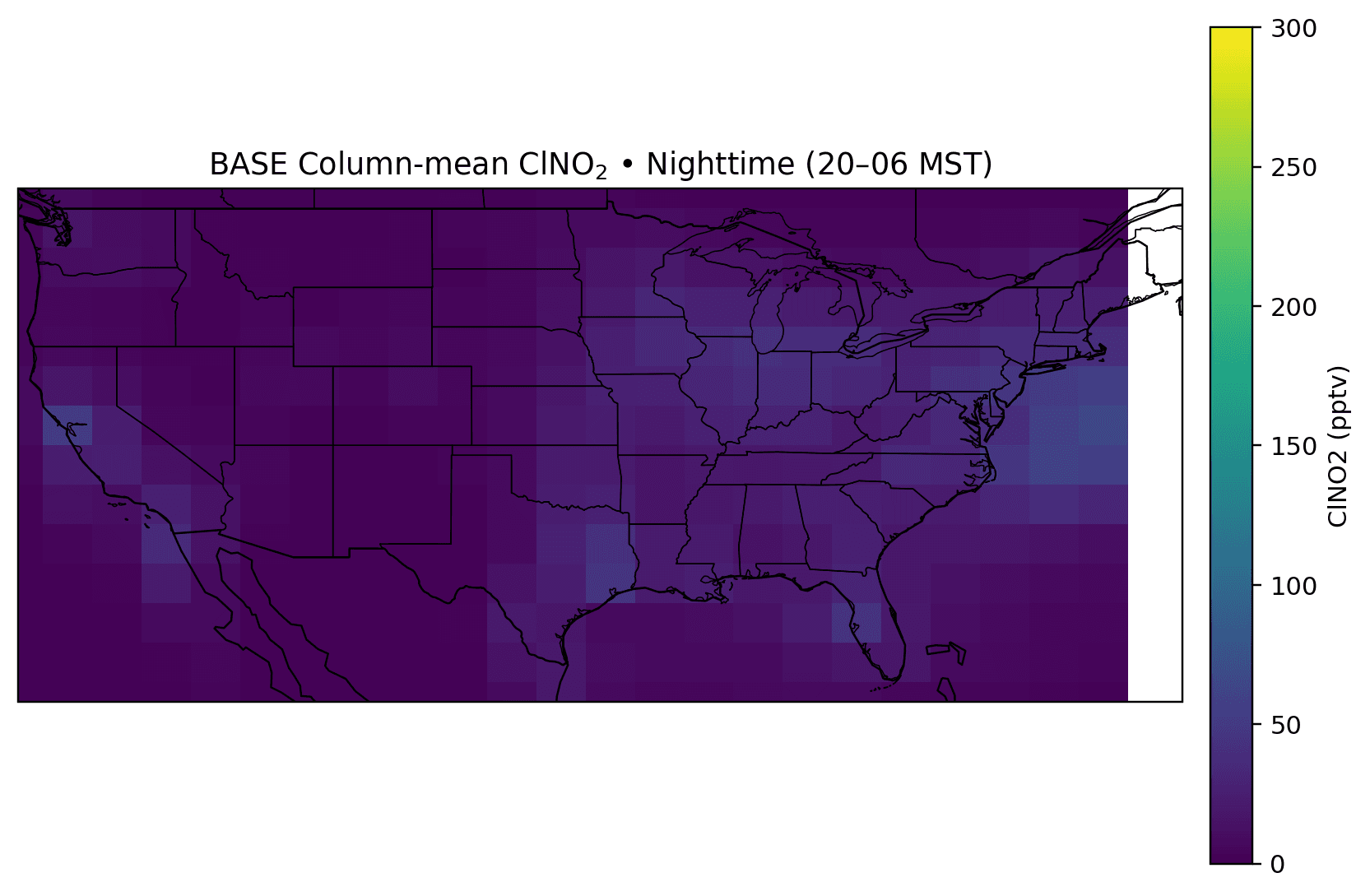
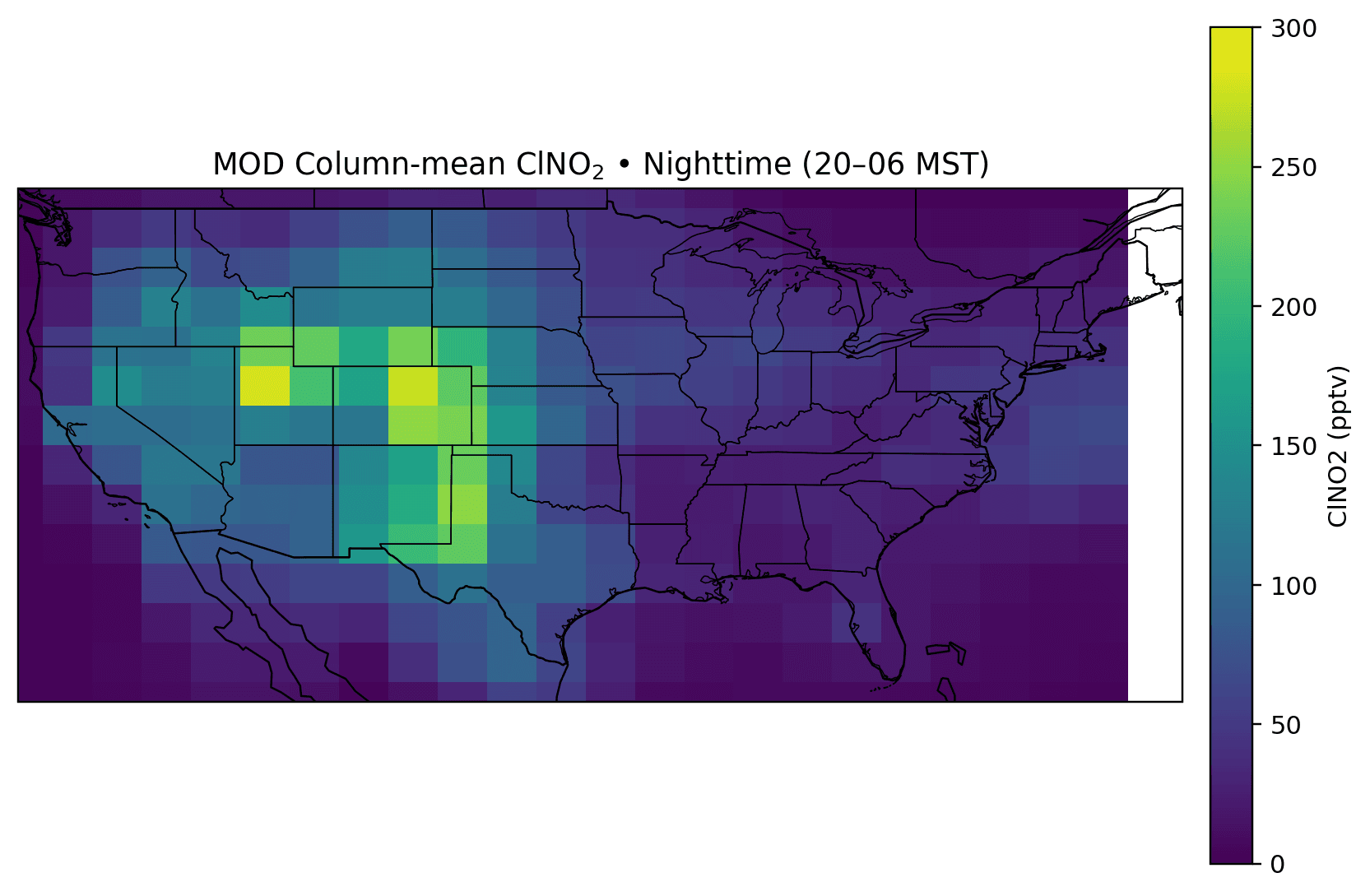
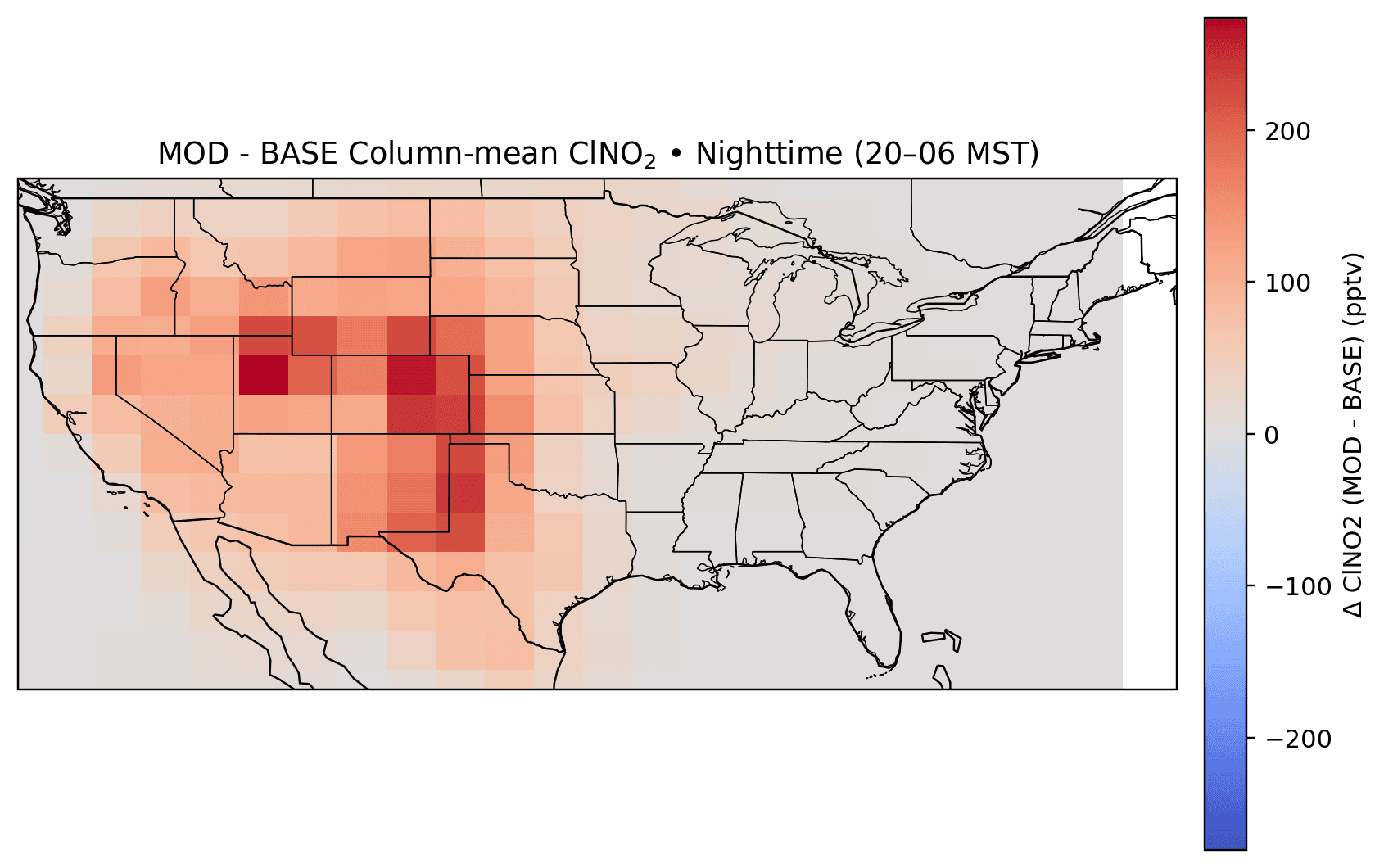
ClNO₂: before, after, and difference
In contrast to the N₂O₅ trends, my modifications to GEOS-Chem introduce a new production pathway for ClNO₂. During the same modeling period, ClNO₂ concentrations increase as expected as playa dust participates in this chemistry. With this production pathway established, playa dust emissions and their influence on ClNO₂ can be further refined, allowing the downwind air-quality impacts of ClNO₂ to be more clearly linked to dust from shrinking saline lakebeds.
Conclusions & Future Work
This work establishes a new framework in GEOS-Chem for representing the secondary-chemistry impacts of shrinking saline lakes. By introducing playa dust emissions into the model and allowing chloride carried by these particles to participate in atmospheric chemistry, the model can now capture chemical pathways that were not previously represented.
While particulate chloride has traditionally been represented in GEOS-Chem through sea-salt aerosols, this work extends that capability inland by explicitly representing chloride carried by dust emitted from drying saline lakebeds. This distinction is critical, as shrinking saline lakes emit dust directly into populated continental regions, where it can interact with pollution in ways that marine sources alone cannot capture.
As saline lakes continue to decline due to climate change and water diversion, the secondary chemical impacts of playa dust are expected to become more important for regional air quality. This framework improves the ability to quantify these impacts, supporting more complete assessments of environmental and public-health consequences and providing scientific context for future research, water management, and air-quality policy decisions.
Sources
References
- Thesis (forthcoming publication): Will be published and linked to my Google Scholar profile
- Modified chemical transport model (my branch): github.com/joeybail96/geos-chem/tree/FENGSHA_CLNO2
- FENGSHA dust model (adapted from D. Mallia): github.com/joeybail96/FENGSHA_python
- GEOS-Chem model: https://geoschem.github.io
- HART Lab (University of Utah): https://atmos.utah.edu/hart-lab/home.php
- Haskins Lab: https://www.jessicahaskinsphd.com
- SSURGO soil database: USDA NRCS Soil Survey Geographic Database (SSURGO)
Note: This is a concise, web-friendly reference list. Full citations will be included in the forthcoming thesis (currently under review) and associated journal articles.